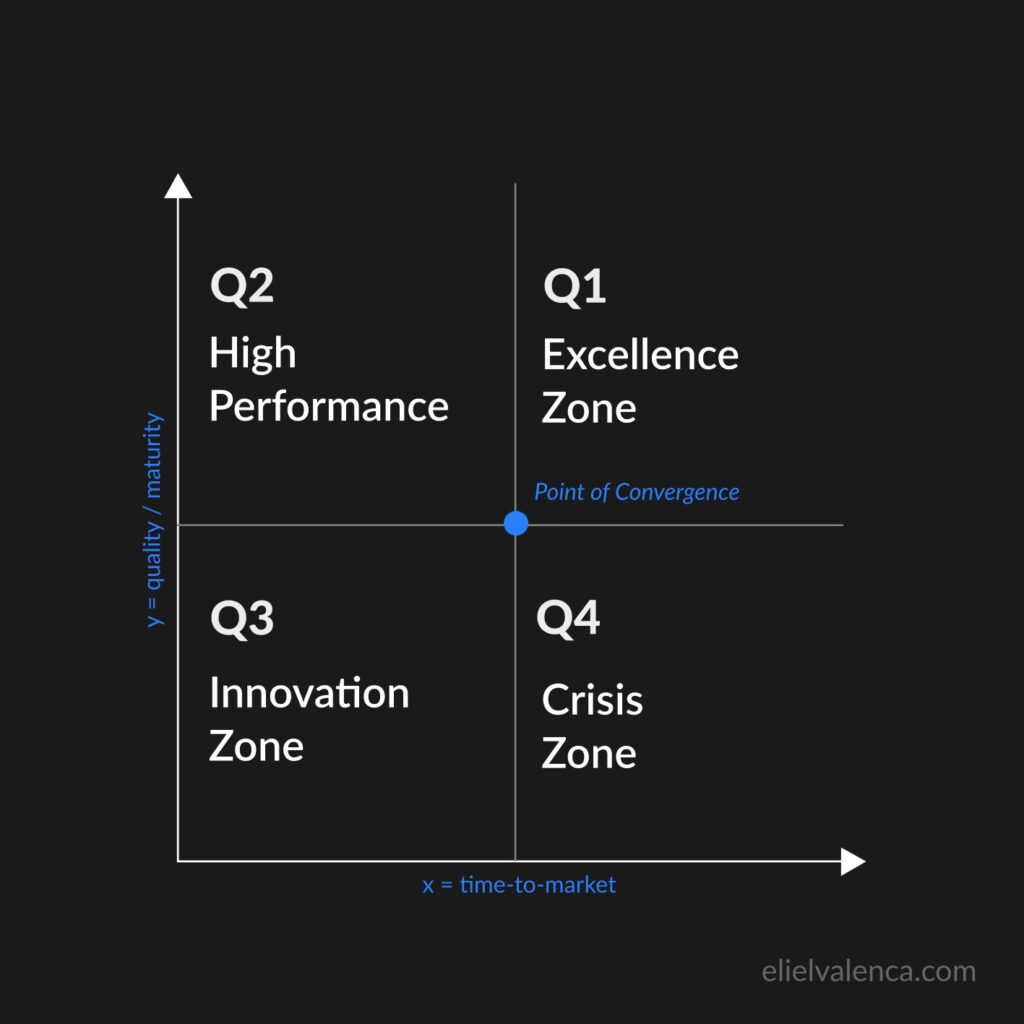
The Technical Leadership Matrix (TLM) is a governance tool for technical leadership. It was designed to demonstrate the role of software engineering alongside business in maintaining the viability of software projects and to foster convergence between Product, Business, and Technology.
In a visual and simple way, we can see the importance of the technical evolution of projects over time and the collapse of technical leadership—or viability—when we fail to evolve software quality and maturity as time passes, leading to the Crisis Zone (Q4).
First, we must establish two fundamental premises:
- Quality and maturity are not accidental: They are not achieved simply through the passage of time. They require intentional action from technical leaders. Engineering is built on choices, processes, and commitment.
- Utopia is the enemy of Business: We do not seek the absolute upper-right corner (infinite maximum quality). Chasing this target without a commitment to time-to-market has created the historical chasm between Product and Technology.
Table of contents (Index)
The Convergence Point
Where business needs meet technical sustainability, we define the Convergence Point. It represents the shortest possible (viable) time to deliver the minimum quality and maturity necessary for the sustainability of the business itself. It is the materialization of efficiency and effectiveness.
Analyzing the Quadrants
With the Time-to-Market (X) and Quality/Maturity (Y) axes mapped, we identify four distinct states for a team or project:
Zone of Excellence (Q1)
Q1 is the quadrant with high quality and maturity but requires the highest possible time-to-market. This is the environment for critical systems or highly consolidated products where error is too costly, but the price of delivery is low speed. This is where R&D teams or Deep Tech companies reside.
High Performance (Q2)
The “magic quadrant.” Usually the home of surgical or highly senior teams. Q2 represents the ability to deliver high quality in a reduced timeframe. It may be a temporary quadrant for specific projects, such as crises or urgent deployments. However, it can also be the quadrant for teams that master their processes, possess robust automation, and an architecture that allows for rapid changes without degradation.
Innovation Zone (Q3)
Q3 is characterized by low time-to-market and quality/maturity that is still under development. This is the space for MVPs and experimentation. It is perfectly acceptable to be here temporarily to validate hypotheses, provided there is awareness that technical debt is being incurred to gain learning speed.
Crisis Zone (Q4)
The dreaded Q4 occurs when time-to-market is high (slow deliveries) and quality is low. This is the collapse of leadership. Here, the team spends most of its time fixing bugs for features that took months to release. Business viability is put at risk in this quadrant.
How to Start Using the Technical Leadership Matrix
The TLM is not just a static graph; it is a diagnostic and dialogue tool. To implement it, consider the following steps:
1. Share it with your team: The simplicity of the model speaks for itself. Presenting the Matrix generates a new state of awareness and maturity across departments, as it replaces subjective perceptions with a clear visual framework.
2. Promote alignment between areas: The matrix serves as a communication “bridge”:
- For the Product Team: Use the TLM to explain why a minimum level of quality is non-negotiable for the health of the business. Create awareness that the horizontal line (Quality/Maturity) is sustained by technical leadership (CTO, GEs, TLs, Staffs). Show that the Innovation Zone (Q3)—the habitat of MVPs—is a temporary stage that must evolve toward the Convergence Point to avoid technical bankruptcy (Q4).
- For the Technology Team: Demonstrate the importance of maintaining the quality line without falling into the Utopia trap (the infinite search for the top right). Discuss how technical inertia inevitably leads to the Crisis Zone (Q4) and how leadership must act effectively to transition from Q3 to stability. Make the Innovation Zone viable and desirable by making it strategic.
3. Establish a Common Vocabulary When everyone understands what the Convergence Point is, negotiations over scope and deadlines stop being a contest of “who shouts loudest” (authority) and start being based on data and viability.
4. Define Quadrant Attributes Except for the Crisis Zone (Q4), all other quadrants are operational. It is up to you to define: What characterizes a High Performance (Q2) team specifically in our company? What defines our Zone of Excellence (Q1)?
Strategic Tip: The Diagonal Movement
To exit the Crisis Zone (Q4), the most effective intervention is usually applying Q2 (High Performance) characteristics—such as autonomy and reducing bureaucracy—rather than attempting an orthogonal move toward Q1 (which typically brings excessive processes and slowness). Seeking agility with quality is the shortest path to recovering viability.
The Matrix in the AI Era
In the original conception of this Matrix, AI-driven code generation had not yet reached the scale and impact observed today.
Currently, I am investigating under what circumstances Q2 (upper-left quadrant) can consolidate itself as the ideal environment for teams focused on AI orchestration—assuming that the Intent and Design layers (from the IDO Paradigm) are duly matured and operational.
This section will be updated as new definitions are validated through practice and experimentation.
This post is an introduction to the Technical Leadership Matrix and is part of my research based on the axiom Viability Precedes Authority. Access the full paper here (preprint).
This content is protected under the CC BY-NC-ND 4.0 license. To cite the Law of Viability, the Technical Leadership Matrix, or the IDO Paradigm in your articles or posts, please link the term to this website or use:
“[Title of the Post/Concept], by Eliel Valença. Available at: https://elielvalenca.com“